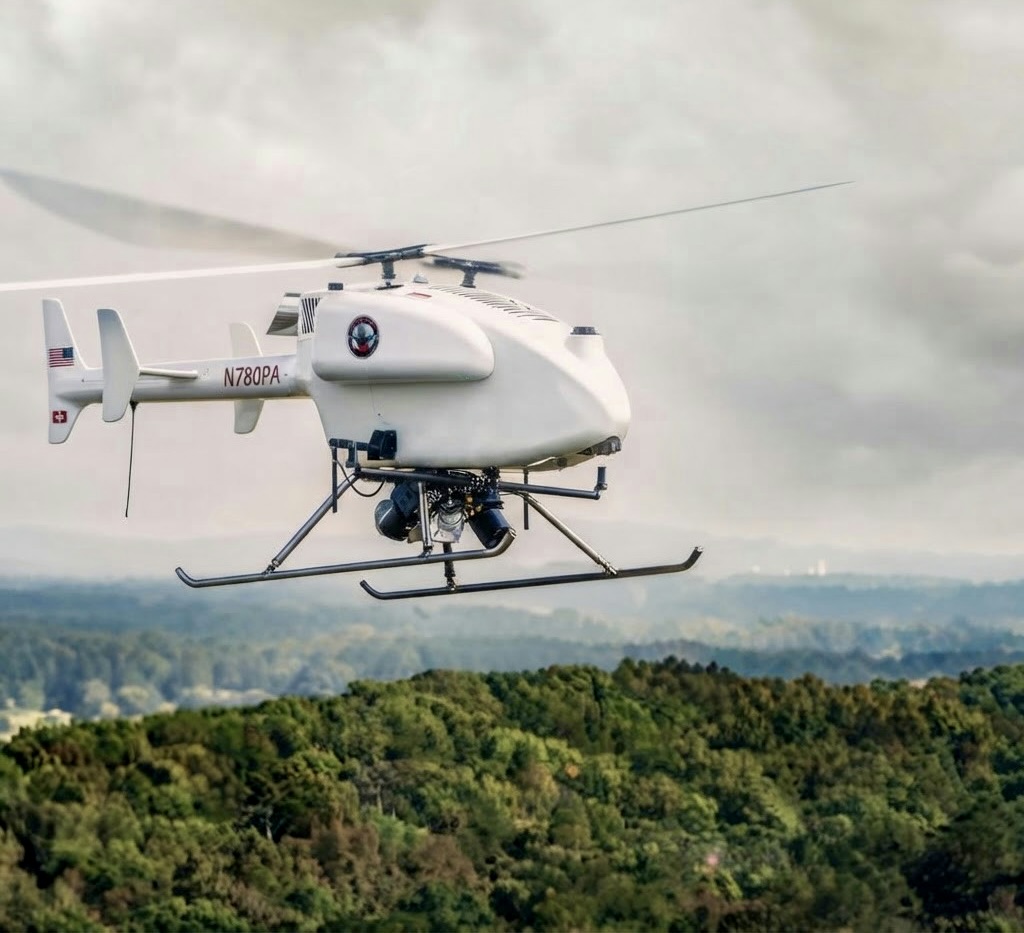
Every year, crewed helicopters fly millions of miles across the globe to simply carry cameras and sensors. They patrol pipelines and sweep remote terrains in search of missing persons or structural faults. For years, this has been the viable option for gathering aerial intelligence at scale. It was expensive, carbon-heavy, and in many cases, unnecessarily risky for the crews involved. Carbon emissions from helicopter-based power line inspection alone are estimated at 11.74 kg of Carbon dioxide per kilometer of power line.
SwissDrones was built to change that. Founded on the conviction that autonomous aerial systems could replace crewed helicopters for long-range missions, the Swiss company has spent years engineering a solution that is safer, more cost-effective, and far more sustainable.
The Problem and SwissDrones' Response The SDO 50 V3: Built for Mission-Critical Performance The problem SwissDrones set out to solve was straightforward in concept but nuanced in execution. Critical infrastructure operators and public safety agencies had to constantly battle between two uncomfortable choices, deploying crewed helicopters in potentially dangerous conditions, or accepting gaps in their aerial coverage. Neither option was ideal. The former carried real risk and steep operating costs and the latter meant blind spots in pipelines, power grids and search areas where stakes could be life-or-death.
While much of the early drone industry chased small, lightweight, and inexpensive platforms suited for short-range consumer applications, SwissDrones focused on building an uncrewed aircraft capable of genuinely replacing a helicopter for serious, long-range missions with heavy professional payloads.
Engineering Philosophy and the Rotor System From Design to Deployment: Enabling Real-World BVLOS Operations The SwissDrone team did not have the luxury of the ‘move fast and break things’ mindset that defines so many technology startups. When you are building aircraft intended to operate in public airspace, near critical infrastructure, and in conditions that would ground conventional drones, every design decision carries consequences. Progress was deliberate.
Global Commercial Vice President of SwissDrones, Christophe Chicandard believes that their rotor system is one of their most significant innovations that goes unnoticed most of the time. He pointed to the technological advantage it brings to the table. He explained, “Our rotor system — a proprietary approach based on Anton Flettner’s intermeshing, counter-rotating double rotor principle reduces mechanical complexity as it does not require a tail rotor and enables higher payloads than conventional rotor systems which results in a payload-to-empty-weight ratio approaching 1:1. This is the kind of design choice that quietly determines whether a platform is a ‘toy’ or a ‘tool’.“.
The combination of autonomous flight capability and genuine payload capacity opened doors that most operators had not imagined. One use case that now sits at the center of SwissDrones' commercial offering is end-to-end, beyond visual line of sight (BVLOS) energy infrastructure inspection at enterprise scale. This is not limited to flying a route and capturing footage. It includes operational planning, flight execution, data acquisition, processing, analysis, reporting, and integration with a client's existing IT and security infrastructure.
Cost Savings and Carbon Reduction Redefining Infrastructure Inspection with Uncrewed Helicopter Systems The results speak to a scale of value that goes well beyond incremental improvement. When customers move from crewed helicopter operations to SwissDrones' platform , operational cost savings of more than 70 percent are achievable, alongside carbon dioxide reductions of up to 95 percent depending on the mission profile. These figures do not represent a modest efficiency gain. They represent a fundamental shift in what is financially and operationally possible for an inspection or surveillance program to achieve.
A concrete example of this capability in action came from Queensland, Australia, where SwissDrones deployed a recurring commercial gas pipeline inspection service across 550 kilometers of outback terrain for a major energy company. The operation produces high-resolution digital twins of the entire corridor, with automated issue detection. To make it happen, the team combined uncrewed helicopters, aviation-grade flight operations, first-in-kind BVLOS regulatory approvals, industry-grade sensors, and AI-enabled data processing. The mission looks uneventful from the outside. That, according to Christophe, is exactly the point.
Culture and Operational Credibility The company has developed a philosophy around this idea. They celebrate the boring wins like clean checklists, predictable setups, and flights that proceed without incident. In an industry that often prizes dramatic demonstrations and headline-grabbing footage, SwissDrones has built a culture that values repeatability above all else. Being uneventful is not a disappointment. It is the goal.
For anyone entering this space today, the company offers a pointed piece of advice. Christophe believes it is crucial to pick one standard and hold to it. For work that matters, the measure of a platform is not how it performs in a demo. It is how it performs on the hundredth mission, in difficult conditions, with real outcomes at stake.
This orientation toward operational credibility rather than spectacle has shaped how SwissDrones approaches the broader drone industry conversation as well. The company has worked to challenge a persistent assumption in the market: that drones are only practical when they are small, cheap, and simple to deploy. For mission-critical applications, this assumption can lead organizations toward platforms that look impressive in controlled conditions but fall short when exposed to the full demands of real-world operations. Endurance, payload capacity, BVLOS readiness, and performance in adverse weather are not optional features for serious missions. They are baseline requirements.
What the World Would Actually Miss Expanding Horizons: Long-Endurance UAV Missions in Action The question SwissDrones poses to the industry is ultimately not about technology. It is about what becomes possible when the right technology is paired with the right operating standards. Without SwissDrones, the conversation around long-range BVLOS helicopter replacement would be smaller, and the number of proven, real-world deployments demonstrating what uncrewed aviation can actually deliver would be fewer.
At a time when organizations across energy, infrastructure, and public safety are under pressure to do more with less, the case for a smarter approach to aerial intelligence has never been stronger. SwissDrones represents what happens when a company refuses to compromise on the things that actually matter in the field. This is reflected in key factors like reliability, endurance, and the kind of safety record that makes regulators and operators alike willing to trust an uncrewed system with critical missions. That combination is rarer than it sounds, and the industry is better for having it.
On a final note, when asked about the void the absence of SwissDrones would make in this world, Christophe mentioned that the loss would be that of a proven path to aerial intelligence without putting people into aircraft.
“SwissDrones exists to replace crewed helicopter missions where risk, cost, and emissions limit what organizations can do. If we disappeared, the world would miss a platform and an operating model designed specifically for long-range BVLOS missions, built around a unique twin-rotor aircraft, enabling organizations to obtain aerial intelligence day and night in challenging conditions, at reduced operating cost, and minimal carbon impact, “ he said.